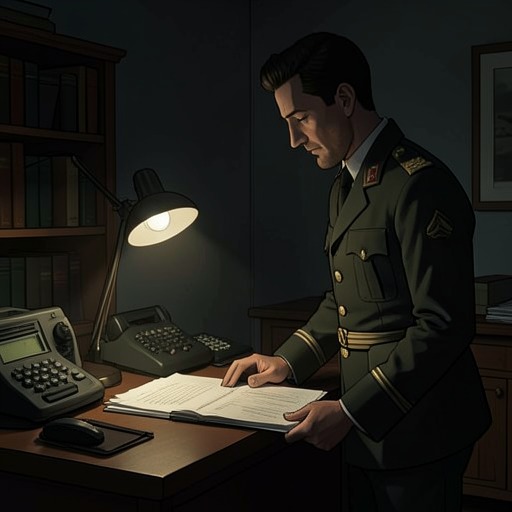
Jérôme Leclerc
An Officer and a SpyJérôme Leclerc is a general serving in Tunisia whose brief intervention gives Georges Picquart a way to return to Paris despite military efforts to keep him away. He does not ask to learn Picquart’s secrets or promise to oppose the authorities openly; instead, he grants a week of compassionate leave and later offers to obstruct an order. His help is guarded, but it has concrete consequences: Picquart can leave Tunisia and continue his unfinished business.
Identity and Introduction
Leclerc appears at his office veranda in shirtsleeves, seated at a portable card table and sorting letters. An electric fan lifts their edges, while his revolver holds the pages down. In his middle sixties, square-jawed and broad-shouldered, he has served in Africa for so long that Picquart describes his complexion as nearly matching that of the local population. The setting gives his command a makeshift, remote quality: he is a senior officer, but stationed far from the ministry whose orders shape Picquart’s fate.
Leclerc greets Picquart with sarcasm, calling him an exotic figure and a man of mystery, and asks what secret has been withheld from his commanding officer. The teasing is not wholly unfriendly. When Picquart asks permission to go on leave to Paris, Leclerc questions why he has come to him and hears that Picquart believes he is more likely than another superior to disregard an order from the General Staff. Leclerc laughs at the assessment, admits he is past caring, and insists that the request needs a serious reason, not merely a wish to see a woman. Picquart answers that he has unfinished business in Paris.
Leave and Practical Assistance
Leclerc authorizes a week away on compassionate leave. He says he does not want to know what Picquart is doing and will not inform the ministry that Picquart has left Tunisia. At the same time, he makes a boundary clear: he will not lie if the ministry discovers the absence. The signed document grants Lieutenant Colonel Picquart of the 4th Tunisian Rifles official permission to leave the country. This is the first official assistance Picquart has received. Picquart’s eyes fill with tears, but Leclerc pretends not to notice, keeping the exchange within the reserve of professional formality.
That permission enables Picquart to travel from Tunis toward Marseille, but it does not make the journey simple or safe. The ferry’s passenger list is full, so Picquart bribes a clerk to obtain a small cabin and keep his name off the manifest. He boards in civilian clothes and stays below deck, avoiding recognition until the ship is out on the Mediterranean. Leclerc’s help is therefore significant precisely because it is limited: he supplies the lawful leave that makes departure possible, while Picquart must still conceal the journey’s practical details.
Obstruction Rather Than Defiance
Leclerc’s support becomes more explicit when Picquart faces an order from Billot to go farther south. Leclerc rejects Picquart’s apology and identifies Billot’s conduct, rather than Picquart’s, as unacceptable. He says he cannot countermand a direct order from the head of the army, but can obstruct it. He directs Picquart to return to Sousse and pretend to prepare for the journey south while Leclerc sees what can be done. He also speculates that Billot may not remain minister much longer if Picquart’s account is true.
The distinction between countermanding and obstructing defines Leclerc’s role. He does not claim authority to cancel the order, nor does he declare an open revolt against it. Instead, he uses the room left by his position to delay or frustrate its execution. His help is candid about its limits: he will not pretend that the order has vanished, but neither will he treat obedience as the only available response.
Relations and Significance
Leclerc’s conduct contrasts with the response Picquart receives from Charles-Arthur Gonse. Gonse tells Picquart to forget the bordereau, later argues that reopening the Dreyfus investigation would reopen wounds and tear the country apart, and finally orders him not to investigate or disclose anything about the case. Gonse also takes control of the Agent Auguste material from Major Henry. Against that pattern of suppression and centralization, Leclerc offers a modest form of assistance from the periphery: leave, silence about Picquart’s departure, and obstruction of a transfer order.
Leclerc is not portrayed as an unconditional advocate for Picquart. His refusal to lie limits what he will risk, and his insistence on not hearing the details preserves distance from Picquart’s cause. Yet that restraint does not erase the importance of his choice. At a moment when military authority is being used to isolate Picquart, Leclerc recognizes the space between openly defying an order and mechanically enforcing it—and gives Picquart enough room to act.